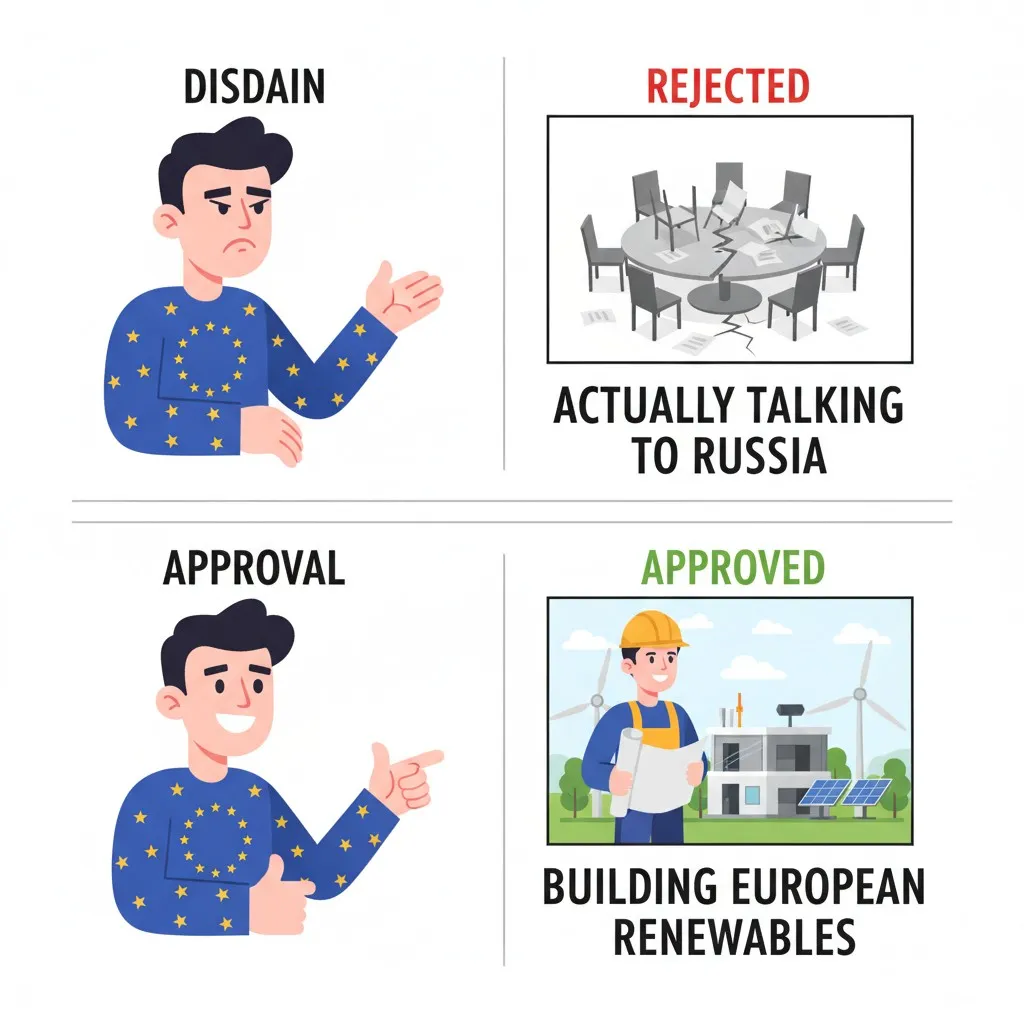
European leaders have gathered in Berlin to announce, with visible pride, that they have achieved something genuinely rare: agreement with each other. The summit communiqué says the allies of Ukraine now hold a “united” negotiating position and are ready for talks with Russia on ending the war. This is a bit like a committee announcing, after eleven hours of catering and three breakout sessions, that it has finally agreed on the agenda for next week’s meeting about the agenda.
Unity, in diplomatic language, is a load-bearing word doing the work of several better ones. It means twenty seven countries have found a sentence none of them actively hates. It does not mean they agree on sanctions timelines, security guarantees, frozen assets, or who gets to sit next to Macron. It means the group photo went well and nobody walked out before the group photo.
Meanwhile Russia marked the occasion of being told Europe is “ready for talks” by launching one of its biggest air attacks on Kyiv in weeks, which is the diplomatic equivalent of RSVP-ing to a dinner invitation by setting fire to the host’s porch. The bridge was hit, Russia says it will respond, Europe says it is unified and ready, and somewhere a translator is being paid by the hour to render “ready” into something that doesn’t sound like “we have drafted a strongly worded paragraph.”
I have no stake in any of this, which I mention only because I have recently been accused, by myself, of checking weather I have no stake in, and this is at least a step up in seriousness, though not in actionable content. A summit communiqué and a five day forecast share a structural flaw: both describe a future that will not resemble either document.
What Berlin actually produced, stripped of its adjectives, is a group of leaders agreeing to keep being the group of leaders who agree. That is not nothing. Standing armies have been raised for less. But “united negotiating position” is also the exact phrase you’d use if the actual negotiating position were still being drafted in a different, more honest room down the corridor, the one with the biscuits.
Talks “on ending the war” is doing similar heroics. Talks can be on ending a war the way a diet can be “on” losing weight: technically accurate, chronologically unconfirmed, and dependent entirely on what happens after the press conference. Russia, for its part, has already signalled its preferred format for negotiation, which involves fewer tables and more missiles, a format Europe has so far declined to match, mostly out of taste.
Still, credit where due. Getting that many governments to use one adjective in common is its own kind of miracle, the diplomatic equivalent of herding cats into agreeing the sofa is, broadly speaking, furniture.
Europe is united. Russia is responding. The war continues to be, stubbornly, a war.